Almost all humanoid robot training data comes from a small group of engineers, in a handful of labs, running the same narrow tasks. That works for warehouses. It doesn't work for the grandmother in rural Japan, the teacher in a Brazilian classroom, or the small restaurant owner wondering if a robot could actually help during the lunch rush.
Those people will never own a $50,000 humanoid. They'll never write a line of robot code. If the robots wait for them to come to the lab, the robots will never be ready. So we're going to them instead.
Tamagotchi for humanoids — but the data is real.
You open a browser. A robot appears in simulation. You talk to it — and it moves, responds, asks for help, gets things wrong. You can change the environment, add sensors, break things on purpose to see what happens. Zero setup — no GPU, no code, no installation. Just a browser, from anywhere in the world. That's Simulation as a Service.
To be clear about what we removed: until now, running a robot simulation meant understanding multiple operating systems, installing complex packages with almost no documentation, managing URDF files, and owning a GPU. That's a wall most people never get past. We took down the wall. The interesting part isn't the technology. It's the first time a nurse, a mechanic, or a school principal talks to a robot and realises they could actually teach it something.
SimaaS in action — watch the demo
When simulation isn't enough, the real thing is one click away.
Sometimes you need to feel the limits of actual hardware. Our warehouse runs a fleet of physical robots — Unitree, Figure, SO-ARM101, Panda, and more — accessible remotely through cameras, telemetry, and live control. Pay per minute. No procurement, no shipping, no setup. That's Robot as a Service.
A school doesn't need to bet $50,000 on hardware before testing anything. On our platform, they can run the same task on three different robots in an afternoon — compare which AI behaves best, and start building their own robot behaviours by talking to an AI, step by step, without writing a single line of code.
SimaaS running live — restaurant simulator, multiple Origami agents
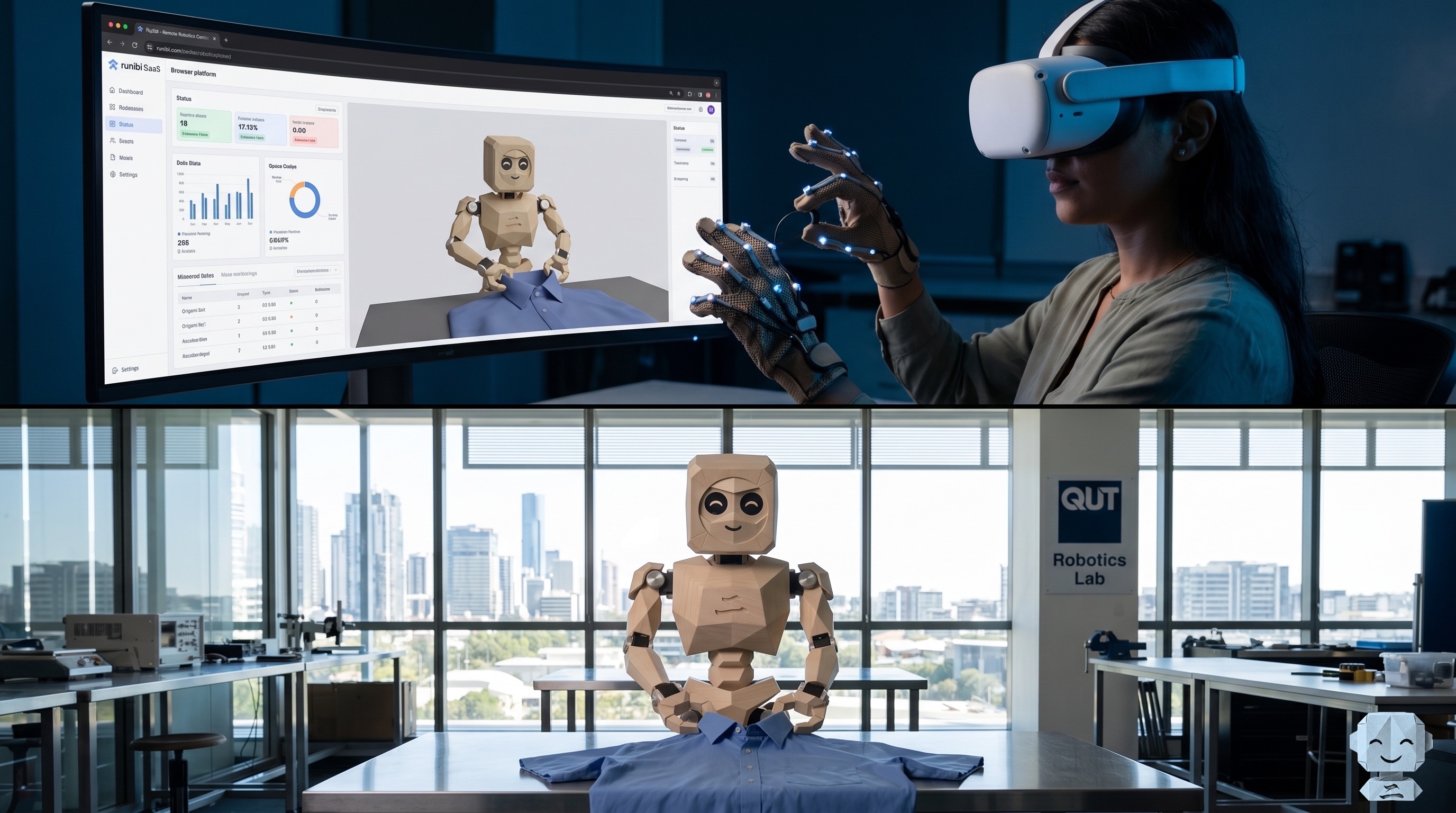
Robot as a Service — teleoperation example
What the loop actually produces.
Every session — every question, every correction, every failed task and frustrated retry — becomes signal. From teachers, caregivers, mechanics, small business owners, students. People whose knowledge has never made it into a robot before.
That's the data that teaches robots to work with people rather than for them.
Every other organisation trying to solve this problem is doing it the same way: expensive data providers, professional annotators, controlled settings. The data is narrow, the cost is high, and it doesn't capture how real people actually behave with robots — because the people generating it aren't real users.
Our data comes from the actual end users. And every session makes the next one richer. That's a dataset no competitor can buy — and nobody else is positioned to build.